Artificial intelligence (AI) is changing the way businesses work. From automating everyday tasks to helping teams analyse information, AI is becoming part of daily business operations. But while companies focus on what AI can do for them, there is another question worth asking: What does it take to keep AI running?
The answer comes down to one basic need: electricity.
AI systems need powerful computers to work, and those computers need a constant supply of power. As demand for AI expands, the UK is preparing for a major expansion of the facilities that support it. This could create new opportunities for businesses, but it could also put more pressure on the country’s electricity network. Such developments are part of wider trends reshaping the UK’s energy infrastructure.
So, is the UK ready for what’s coming? Let us take a closer look.
What are AI Data Centres?
Before we look at the impact on the electricity grid, it is worth understanding what AI data centres actually are.
AI data centres are large facilities packed with powerful computers that help train, develop and run AI systems. These computers process huge amounts of information and carry out complex calculations. AI processors generate substantial heat, so advanced cooling systems are needed to keep the equipment operating safely.
In contrast to a regular office, where electricity is used to power lights, computers and other equipment, AI data centres can use large amounts of electricity every hour, often throughout the day and night.
The more AI services we use, the more computing power we need. This is why companies are investing in new data centres and expanding existing ones.
And this is where the UK’s energy challenge begins.
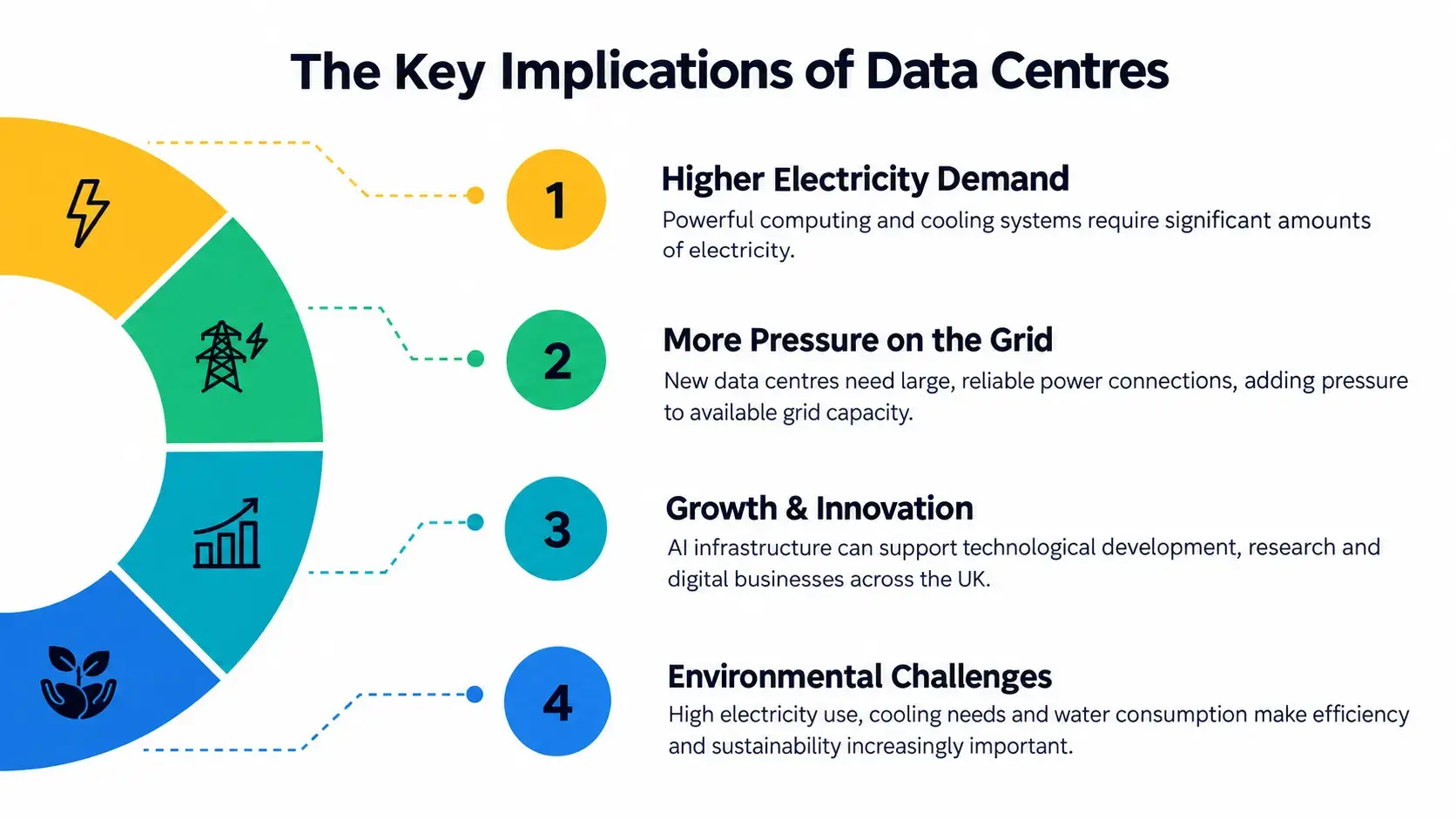
The UK’s Plans for AI Boom
The UK is positioning itself as a key player in the AI sector. To support this goal, the government is encouraging investment in the infrastructure needed to develop and run AI systems.
In its UK Compute Roadmap, the government set out plans to increase the country’s AI computing capacity. One of its targets is to have at least 6 gigawatts (GW) of AI-capable data centre capacity by 2030.
To put that into perspective, 6GW represents a substantial amount of potential electricity demand. It is important to remember that this is a target for computing capacity, not a guarantee of how much electricity will actually be used at any given time.
The government is also planning AI Growth Zones. These areas are intended to make it easier to develop the infrastructure needed for AI and attract investment into the UK.
These plans could support new jobs, investment and technological development. However, they also raise an important question: Where will all the electricity come from, and how will it reach these new facilities?
Why is the Electricity Grid under Pressure?
The UK’s electricity network is already going through major changes.
The country needs to connect more renewable energy projects, support the growing use of electric vehicles and heat pumps, and meet the changing energy needs of homes and businesses. At the same time, the existing grid needs upgrades to keep up with new demand.
Adding large AI data centres to the picture makes the task harder.
The UK data centre electricity demand outlook is changing as more facilities are planned and existing sites expand. These projects need a reliable electricity connection, and some may require substantial amounts of power.
One challenge is that a company may have the funding and technology to build a new facility, but it cannot start operating until it has access to enough electricity.
In some parts of the UK, the grid does not have enough spare capacity to support new projects immediately. Upgrading substations, installing new cables and strengthening transmission networks can take years.
Too Many Projects, Not Enough Connection Capacity?
Another issue is the number of data centre projects waiting to connect to the electricity grid.
In July 2026, Ofgem proposed new measures to improve the way data centre connection requests are managed. The regulator raised concerns about the rapid growth in applications for new electricity demand connections.
According to Ofgem, applications had grown from 41GW to 125GW in less than a year, with data centre projects accounting for at least 80GW of the total.
These figures refer to requested connection capacity, not the amount of electricity that data centres are currently using. Some proposed projects may never be built.
Ofgem’s proposals include a commitment fee and project milestones. The idea is to make sure that projects applying for grid connections have genuine plans and are making progress.
In simple terms, the aim is to prevent projects that are unlikely to go ahead from taking up valuable space in the connections queue.
More Demand Could Mean Higher Energy Costs
When we talk about the impact of AI data centres, it is easy to focus only on how much electricity they consume and will need in the future. But there is another part of the story: the cost of delivering that electricity.
The UK needs to invest in its electricity network to meet future demand. This includes upgrading transmission lines, building substations and improving the infrastructure that moves electricity around the country.
These upgrades require significant investment, and some of the costs are recovered through network charges paid by electricity users.
There is also the issue of grid constraints.
A grid constraint occurs when the network cannot transport electricity to where it is needed. For example, a windy day may produce plenty of electricity from wind farms in Scotland, but the transmission network may not have enough capacity to send all that power to areas further south.
In these situations, the system operator may need to pay some generators to reduce their output and arrange electricity from other sources.
The National Audit Office has highlighted concerns about delays to the UK’s electricity transmission upgrade programme. It has also reported that the cost of managing these constraints reached £1.9 billion in 2025–26 and could increase up to £7.8 billion by 2030 without concerted action.
For businesses, the key point is that energy costs depend on more than just wholesale electricity prices. Network investment, system balancing and the cost of managing the grid can also affect the wider energy bill.
What Could This Mean for Business Electricity Rates?
For businesses, changes in electricity demand and network investment raise questions about future business electricity rates.
It is important not to jump to conclusions. The growth of AI data centres does not automatically mean that every business will face higher electricity rates. Prices depend on several factors, including wholesale market conditions, network charges, government policies and the overall balance between electricity supply and demand.
However, as the UK invests in new infrastructure and manages a more complex electricity system, businesses may need to pay closer attention to the factors that influence their energy bills.
This is where having a clear understanding of your business energy costs can make a difference.
What Does the AI Boom Mean for UK businesses?
You might be thinking, “We do not run a data centre, so why should this matter to us?”
It is a fair question. Most businesses will not be directly involved in building AI facilities, but the growth of AI could still affect the wider energy market.
Here are some developments worth keeping an eye on.
1. Energy Demand Could Continue to Change
As more data centres and other electricity-intensive businesses connect to the grid, the UK’s overall electricity demand is likely to shift.
This does not automatically mean that every business will see higher energy bills. However, it makes it more important to understand the factors that influence energy prices and plan energy management accordingly.
2. Grid Connections Will Matter More
If your business is opening a new site, expanding its premises, or installing energy-intensive equipment, electricity capacity should be part of your early planning.
Checking whether the local network can support your plans could help you avoid unexpected delays.
3. Energy Efficiency Will Remain Important
As demand for electricity grows, businesses may benefit from taking a closer look at how they can adopt smart energy use.
Simple steps such as monitoring consumption, improving equipment efficiency and reducing unnecessary energy use can help businesses manage their costs.
Larger organisations may also explore on-site generation, battery storage or demand-side flexibility, depending on their circumstances.
4. The Energy Market Could Offer New Opportunities
A more flexible electricity system may create opportunities for businesses that can optimise their energy consumption.
Some organisations may be able to take part in demand-side response programmes or benefit from arrangements that reward them for changing when they use electricity.
The suitability of these options will depend on a business’s operations, energy usage and the arrangements available to it.
So, is the UK Grid Ready for the Data Centre Boom?
The short answer is that the UK is preparing for the growth of AI, but significant challenges remain.
The government has set ambitious targets for AI infrastructure. Ofgem is working on reforms to improve the connections process, while network investment is intended to support growing electricity demand.
However, the scale and speed of this expansion create real challenges. Building new grid infrastructure takes time, and connecting large electricity users requires careful planning.
There is no single solution. The UK needs a combination of network investment, reliable electricity generation, better planning and smarter energy use.
For businesses, the message is simple: AI may be a technology story, but its growth will also have an impact on the energy market.
Whether you are reviewing your next energy contract, planning a business expansion or looking for ways to reduce consumption, it is worth keeping an eye on how the UK’s electricity system is changing.
The AI boom is gathering pace. Now, the UK needs to make sure its power infrastructure can keep up.