Market-wide
Half-Hourly
Settlement
What is MHHS?
Market-wide Half-Hourly Settlement (MHHS) represents a fundamental shift in how the UK electricity market operates. Driven by Ofgem and delivered by Elexon as the Senior Responsible Owner, and implemented collaboratively by suppliers, data and metering service providers. It represents one of the most significant transformation programmes in the UK energy market in recent decades.
Why MHHS Matters?
Under the existing settlement framework, many electricity customers with traditional non-half-hourly meters are settled using profiling data.
MHHS changes this fundamental mechanism by:
Under the new regulations:
- Settling electricity consumption on a half-hourly basis (every 30 minutes).
- Aligning supplier settlement with actual usage data collected from advanced and smart metering systems.
- Improving industry visibility enabling more efficient balancing, forecasting and network planning.
Did you know?
MHHS is the biggest energy reform since 1998, powering a smarter, greener grid. If you have a smart or advanced meter, you are likely ready. If you have an older meter, we may recommend an upgrade to ensure you get the full benefits of accurate data.

Why is MHHS being introduced?
It supports the net-zero target.
It creates a flexible, cleaner grid that can use more renewable energy.
It reflects actual consumption.
Energy is settled based on real usage, giving more accurate data.
It empowers businesses by
providing their actual energy data, helping them make smarter decisions.
How is electricity settlement changing?
MHHS is mandatory across the electricity market. The following changes have been made :
Metering arrangements
- Existing meters can continue to operate under MHHS.
- Meter upgrades are not mandatory solely because of MHHS.
- Smart and advanced meters are configurable to provide half-hourly data directly.
Industry role changes
MHHS introduces new arrangements for metering and data services, including:
- Separation of metering and data services by meter type.
- Replacement of existing Data Aggregator and Data Collector roles.
- Increased transparency in metering and data services.
These changes are managed at the industry level and do not affect electricity supply continuity.
MPAN top-line changes
As part of MHHS, the top line of the MPAN (Meter Point Administration Number) will change.
- The Meter Time Switch Code (MTC) is replaced by a Standard Settlement Configuration ID (SSC ID)
- The Line Loss Factor Class (LLFC) is replaced by a DUoS Tariff ID
These updates affect how meters are identified but do not change your electricity supply or contract terms
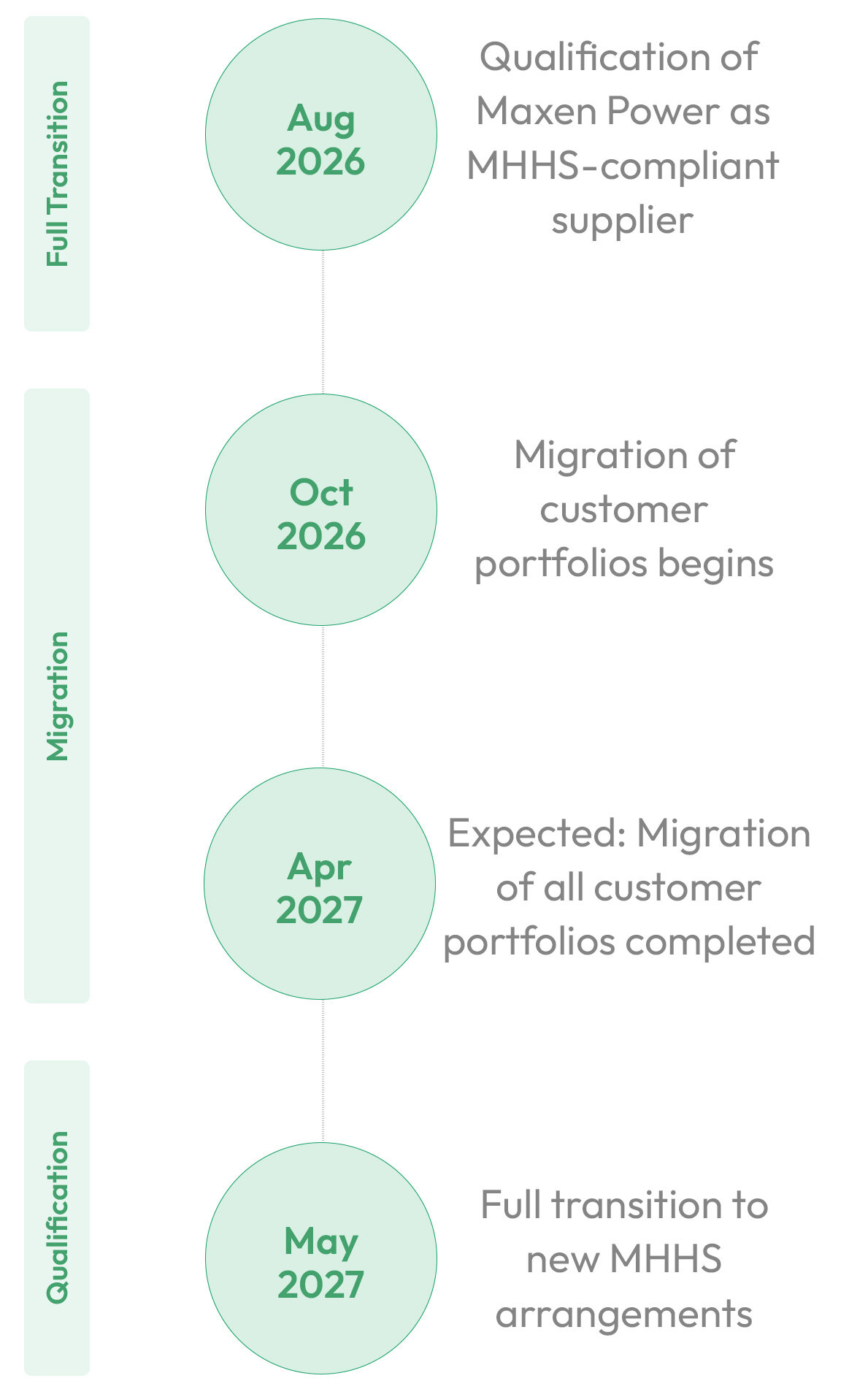
MHHS Migration Timeline
Here’s how we are moving to MHHS, step by step.
Qualification
Migration
Full Transition
Aug 2026
Oct 2026
Apr 2027
May 2027
Qualification of Maxen Power as MHHS-compliant supplier
Migration of customer portfolios begins
Expected: Migration of all customer portfolios completed
Full transition to new MHHS arrangements

Do customers need to take action?
No immediate action is required.
- Electricity supply continues as normal.
- Existing contracts are not automatically changed.
- Customers will be contacted if any action is required.
Read Our MHHS Blogs
Read our latest insights on A New Era of Transparency in Your Electricity Billing and discover practical strategies in MHHS Business Energy Efficiency.
MHHS Reference & Terminology
Use our helpful MHHS Glossary to understand your terms and acronyms, making it easier to navigate this industry development.
MHHS: Video Walkthroughs
Watch our detailed breakdown on the MHHS YouTube Video Guide and explore further updates through our Extended Video Series.
Frequently Asked Questions
Is MHHS mandatory?
Yes. This is an industry-wide regulation mandated by Ofgem. All suppliers and consumers must transition; it is not optional.
Will my power be interrupted during the switch?
No. The switch to MHHS is primarily a data and back-office process. It will not interrupt the physical supply of electricity to your premises.
Do I need a new meter?
If you have a smart or advanced meter, you are likely ready. If you have an older meter, we may recommend an upgrade to ensure you get the full benefits of accurate data.
Will this cost my business more?
The program is designed to reduce overall industry costs by improving grid efficiency. While it changes how costs are calculated, it also opens up opportunities for you to save money through flexible usage.
What if I already have a advanced (half-hourly) meter?
If you are already settled half-hourly, nothing changes for you. MHHS simply standardises this superior approach across the entire market.
What do I need to do?
You don’t need to take any immediate action. Simply ensure your contact details with us are up to date so you receive all communications.
Industry References & Further Reading
For detailed regulatory information, please visit the official industry bodies: