Running a business means keeping track of plenty of costs, and energy bills are an important one to understand. While the unit rate often gets most of the attention, there is another charge that appears on your bill every month, whether your business is busy, closed for the weekend or temporarily not using any energy.
This is known as a standing charge. For businesses, understanding how this fixed daily charge works can help you make sense of your energy bill, compare business electricity rates more effectively and get a clearer picture of your overall energy costs.
In this guide, we will explain what a business energy standing charge is, what it contributes towards, why you pay it even when you use little or no energy, and how it can affect the total cost of your business energy contract.
What Does Standing Charge Mean?
Let’s start at the beginning, because getting the basics right makes everything else click into place.
A standing charge is a fixed daily amount included in your energy tariff, which applies regardless of how much energy you use. It is there every day whether your business is running at full speed or closed for the holidays.
The standing charge contributes towards the costs associated with supplying energy to your premises, including network, metering and supplier-related costs. The exact way these costs are recovered through the standing charge and unit rate depends on your supplier and contract.
One thing worth keeping in mind: the energy standing charge is separate from what you pay for the electricity you actually use. That part of your bill is covered by your unit rate, which is mentioned below. Let’s give it a read!
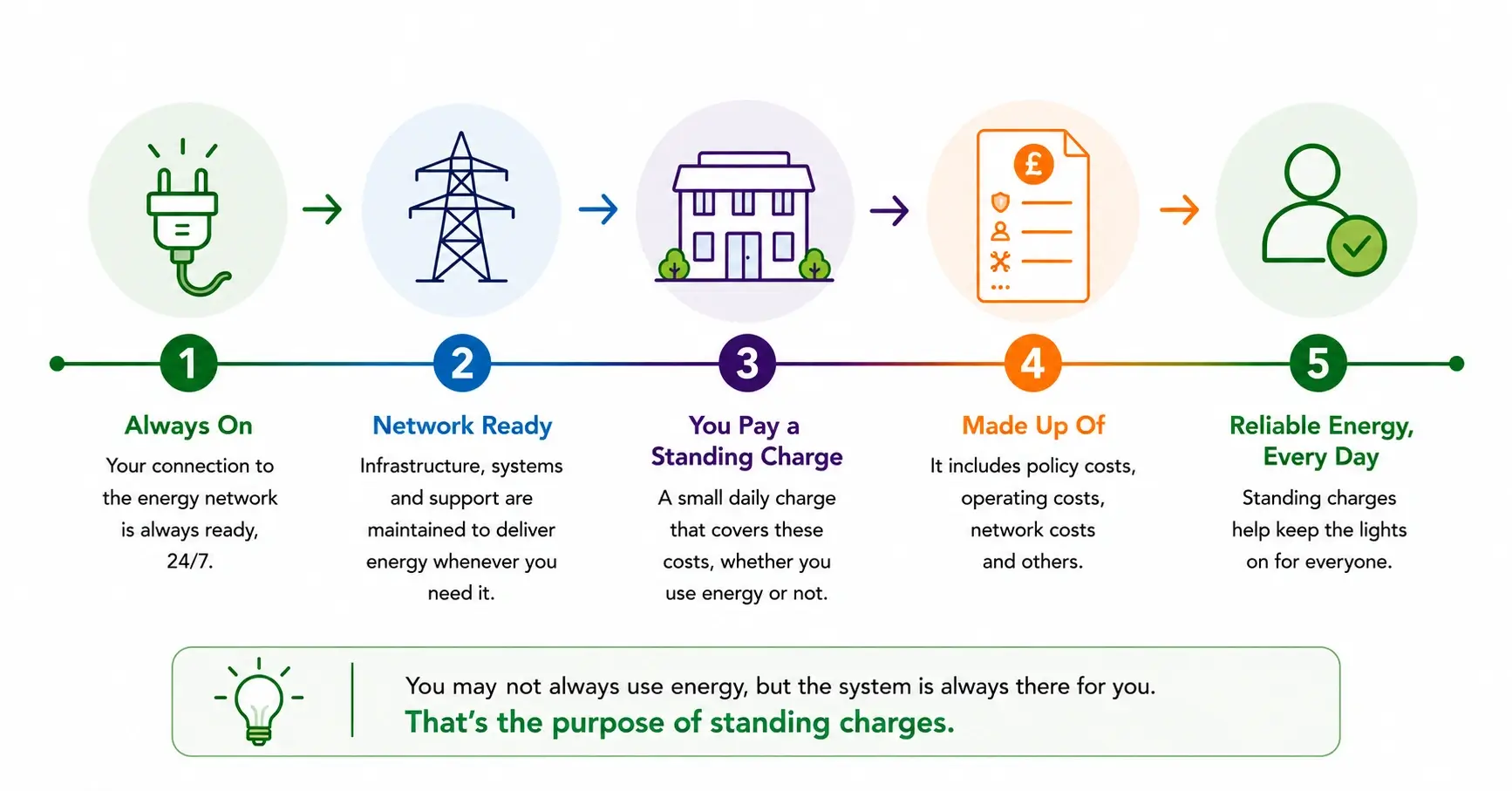
What Are You Actually Paying For?
It helps to know that the standing charge for electricity works a little differently from other utilities like gas. So let’s break this down.
Your electricity standing charge is a fixed daily charge associated with your electricity supply. It contributes towards the costs involved in supplying and maintaining your connection, metering and the wider energy service provided to your premises.
Business energy contracts are not covered by Ofgem’s domestic energy price cap. The price cap applies to certain domestic default tariffs, so businesses generally negotiate their energy prices and contract terms directly with suppliers. As a result, the standing charge you pay as a business is determined by your supplier, tariff and contract terms, and can differ notably from domestic charges.
Know About Electricity & Gas Standing Charge
Electricity Standing Charges
A business electricity standing charge is a fixed daily amount included in your electricity tariff. You pay it for each day your electricity supply remains active, regardless of how much electricity your business uses.
The standing charge contributes towards the costs associated with providing and maintaining your electricity supply, which can include network, metering and supplier-related costs. The exact way these costs are reflected in your standing charge and unit rate depends on your supplier and contract.
For example, a small office, retail premises or warehouse may all have different standing charges depending on factors such as their location, meter type, supply arrangements and contract terms. It applies to your business electricity bill as a pence-per-day figure and ticks along steadily in the background, whatever kind of day your business has had.
Your standing charge is separate from your electricity unit rate. The unit rate is what you pay for each kilowatt-hour (kWh) of electricity you use, while the standing charge is a fixed daily amount.
Gas Standing Charges
A business gas standing charge is also a fixed daily amount that applies to your gas supply. Like electricity, it is payable regardless of how much gas your business uses on a particular day.
The charge contributes towards the costs associated with supplying gas to your premises, including elements such as network, metering and supplier-related costs. The amount you pay will depend on your tariff, contract and business supply arrangements.
Your gas bill will also include a unit rate, which is the price you pay for the gas your business consumes. Although gas meters measure the volume of gas supplied, usually in cubic metres (m³), this volume is converted into kilowatt-hours (kWh) for billing, taking factors such as calorific value into account.
For businesses that use gas for heating, hot water, cooking or industrial processes, comparing both the standing charge and unit rate is important when assessing the overall cost of a gas contract.
What’s Inside a Business Electricity Bill?
Think of your business electricity bill a bit like a recipe. Once you can see all the ingredients, the final dish starts to make a lot more sense.
At a headline level, an energy tariff typically consists of two main pricing elements: the unit rate and the standing charge. Behind these prices are various costs associated with supplying energy.
Wholesale costs are one of the major components of the overall cost of supplying electricity. Your overall business energy price reflects a combination of wholesale energy costs, network charges, policy costs, taxes, metering and supplier costs. These costs can be reflected across the unit rate, energy standing charge, or other charges depending on your contract and supplier.
Seen this way, the fixed daily charge becomes less mysterious. It is one part of the overall cost of supplying energy to your business, alongside the unit rate and any other applicable charges.
What About Nuclear RAB?
Nuclear RAB stands for Nuclear Regulated Asset Base. It is a regulated funding model designed to help finance new nuclear projects by allowing regulated revenue to be recovered during the project’s development and operation. Sizewell C is currently the UK nuclear project using the RAB model.
Why Pay Even When You Use No Energy?
Even when your business is not consuming electricity, the costs associated with maintaining your connection and providing the energy service do not disappear. A standing charge helps suppliers recover some of these fixed or less usage-dependent costs.
The important point is that some costs associated with maintaining an energy supply do not fall to zero simply because your business temporarily uses less energy.
Bringing It All Together
Every charge on your bill has a purpose; knowing what your energy bill covers put you in a stronger position to make informed decisions. With this knowledge, you can evaluate what you are actually paying with better clarity and identify opportunities to keep energy costs in line.