The UK record-breaking heatwave is doing more than making people sweat. It is placing Britain’s power grid under increasing pressure, driving up electricity demand and changing how homes and businesses consume energy. You feel it before reading a weather forecast. The steering wheel is too hot to touch.
Office air conditioners are working overtime but still losing the battle. Walking across the car park feels like stepping into a wall of heat. This summer, Britain has not simply experienced warm weather; it has faced one of its most intense and record-breaking heatwave seasons in recent history.
With every new heatwave, electricity demand rises as cooling systems work harder, making energy efficiency an increasingly important priority for businesses across the UK.
Why is the Power Grid Under Operating Strain?
While we seek relief from the heat, Britain’s power grid is working harder than ever. Every extra degree sends electricity demand climbing as fans, air conditioners, and cooling systems are switched on simultaneously, drawing more power from the grid.
Electricity demand during a heatwave can rise much faster than during normal seasonal changes. Although Britain has a diverse electricity mix, increasing generation at short notice is not always straightforward. Grid operators must continuously balance electricity supply and demand in real time, making periods of extreme heat particularly challenging to manage.
This sudden surge in electricity demand puts Britain’s power grid under intense pressure, just as extreme heat can also reduce the efficiency of power stations and transmission lines.
The result?
The power grid has to operate under increasing strain. During the July 2026 UK heatwave, the pressure became so intense that the National Energy System Operator (NESO) issued rare electricity supply warnings and called on additional power generation. However, these warnings were precautionary, and electricity supplies remained secure, with no planned blackouts.
How Do Heatwaves Affect Business Energy Bills?
Rising temperatures do not directly increase electricity prices, but they significantly increase energy consumption. Cooling systems, refrigeration equipment, ventilation units, and IT infrastructure all work harder during prolonged periods of heat.
Businesses operating during peak demand periods may also experience higher electricity costs depending on their energy contract and tariff structure. This makes energy monitoring and efficient cooling practices increasingly important during summer.
A Summer Britain Won’t Forget
The UK is under the spell of extreme temperatures, experiencing its third heatwave of the year. With each heatwave leaving a bigger influence than the last.
This all began on 22 May, and the country experienced the hottest day two days later (on 25 May 2026), when the temperature reached 34.8 °C (94.6 °F) at Kew Gardens in London, surpassing the previous record that had stood since 1992.
Barely a month later, the second heatwave started on 19 June and saw more records broken. On 26 June, Lingwood, Norfolk, recorded 37.7°C (99.9°F), making it not only the hottest June day ever recorded but also the sixth-hottest day in UK history.
Then came the third heatwave, beginning on 4 July with temperature peaking at 35.5 °C (95.9 °F) in Wisley, Surrey. This marked the eighth day of 2026 when the temperature exceeded 34 °C (93 °F) in the country.
All of the three official UK heatwaves within just a few months illustrate how unusually persistent this summer has been. Rather than isolated spells of hot weather, Britain has experienced prolonged periods of extreme temperatures that continue to place pressure on infrastructure, healthcare services, and electricity demand.
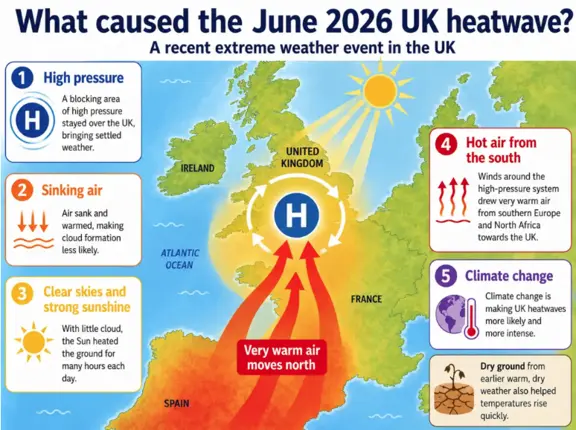
Image Credit: Internet Geography
When the Weather Becomes a Health Warning
The extreme heat is a genuine risk to life, posing serious health risks, particularly for vulnerable groups. Amber heat-health alerts have been issued by the UK Health Security Agency (UKHSA) across all regions of England except the North East, which remains under a yellow alert. During June’s peak temperature, London Ambulance Service had its fifth-busiest day on record on the 24th, then broke its own record just two days later, handling nearly 8,900 calls in a single day. These calls include a record number of the most serious, life-threatening incidents.
For businesses, this also highlights the importance of maintaining safe workplace temperatures and ensuring staff have access to water, ventilation and suitable rest breaks during extreme heat.
It is Not Just People Feeling the Heat
Hospitals have felt this too. At one Portsmouth hospital, failing cooling units knocked out operating theatres and diagnostic scanning facilities all at once. It is a stark reminder that heat does not just affect people directly; it can take down the very infrastructure meant to help them.
Even the railways buckled, quite literally. Intense heat caused rail tracks between Coventry and Leamington Spa to bend, forcing services to be suspended while signalling failures disrupted trains travelling towards London. When temperatures become hot enough to deform railway infrastructure, it is a clear sign that this is no ordinary heatwave.
Similar challenges have also affected schools, data centres and commercial buildings where cooling systems have been pushed beyond their normal operating capacity.
The Real Impact on Your Business
Wait, does this weather have something to do with businesses across the UK? More than you might expect. If you run a business, you have probably noticed something else too, quietly, in the background. Your business electricity usage has been paying closer attention to this heat than you have.
At first glance, a UK heatwave does not seem like a business problem. It feels more like an excuse to complain about the office air conditioning, grab another iced coffee, or wish for rain. But behind the record temperatures lies a story most businesses never see.
Every degree the thermometer climbs places extra pressure on Britain’s electricity network. More cooling means higher demand and an extra burden on the electricity system. And when that infrastructure comes under pressure, your energy bill often feels it too.
This summer, Britain is feeling the heat, and your energy bills will feel it even more.
How to Keep Your Space Cool in This Heatwave?
For commercial properties, energy usage naturally climbs during heatwaves. But here is the good part. Businesses that plan ahead are better positioned to survive the heat while keeping energy usage under control. As the saying goes, ‘a stitch in time saves nine,’ and a few adjustments now can spare you much higher costs tomorrow. Looking to optimise your energy use during this sweltering heat? Start with these smart energy-saving habits.
And most importantly, look after your people or any pets around your place.
Keep Customers in Mind As Well
If people are stepping into your space or looking for relief from the heat, arranging a shade near the entrance or offering water can go a long way for goodwill. This gesture shows that you are concerned about them, and customers feeling looked after tend to linger a little longer too, a win-win situation for your business.
Stay Ahead of the Heat
This summer has given Britain plenty to talk about. 2026 UK heatwaves demonstrate that extreme weather is becoming less of an exception and more of a business consideration. Understanding how rising temperatures affect energy consumption today can help businesses reduce costs, improve efficiency and prepare for future summers.
By monitoring electricity usage, maintaining cooling systems and adopting smarter energy habits, businesses can stay comfortable, control operational costs and remain resilient, whatever the weather brings.
Every cloud has a silver lining, and this one is simple: a business owner that consider how this heat can affect the overall energy use is better placed to improve energy efficiency and keep the costs down